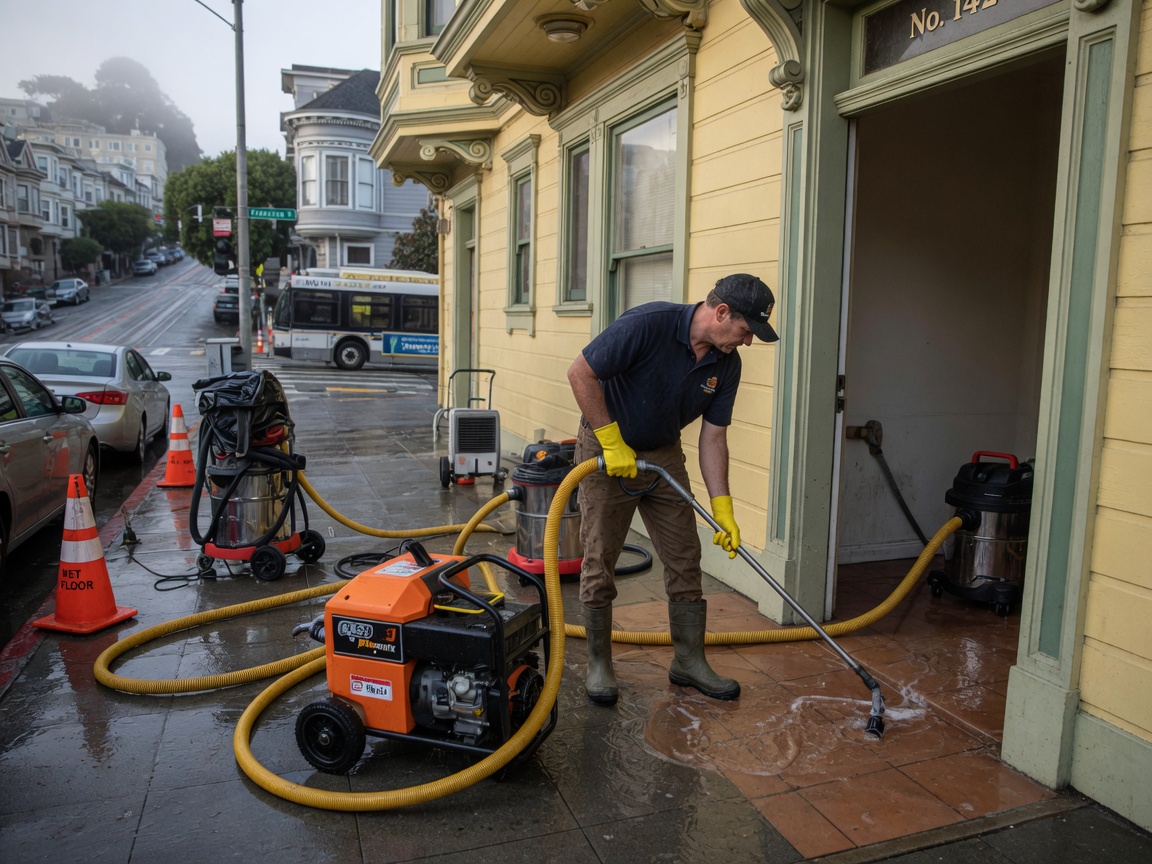
San Francisco's older housing stock, especially Victorians and Edwardians built before 1930 in the Mission District and Bernal Heights, often features cast-iron pipes and lath-and-plaster walls that let water travel far before it surfaces. Winter rains combined with the city's clay-heavy soils push groundwater against foundations, creating slow seepage that saturates subfloors and requires targeted extraction rather than simple mopping. Technicians must account for seismic retrofits that can trap moisture behind new shear walls, turning a small leak into hidden mold growth within 48 hours.
Water removal here frequently involves multi-unit buildings where a single apartment leak affects units above and below. Crews use portable extractors and moisture meters to map migration through shared walls without unnecessary demolition. In neighborhoods like the Castro and Noe Valley, steep hills mean water flows downhill into lower-level units, so extraction plans start at the lowest point and work upward to avoid re-wetting already dried areas.
After extraction, drying must address San Francisco's naturally high humidity and frequent fog, which slow evaporation compared with drier inland cities. Technicians place air movers and dehumidifiers in patterns that account for limited outdoor venting options in dense blocks. Failure to reach hidden cavities behind built-in cabinetry common in 1920s flats often leads to callbacks weeks later.
Technician insight
In San Francisco, the thing that catches most people out with water removal services is how quickly water travels through the balloon-framed walls of pre-1920 Victorians in the Mission; a leak on the second floor can reach the ground-floor subfloor before anyone notices.
Mission District Victorian Leak
A second-floor pipe leak in a 1908 Victorian sent water down interior walls into the first-floor unit below. Extraction focused on pulling water from the balloon framing cavities without opening every wall. Targeted drying and moisture checks prevented mold in the shared structure and allowed both units to return to normal use within four days.
Water Removal Services Services We Offer
✓Emergency Water Extraction
Rapid removal of standing water from burst pipes or appliance failures before it reaches neighboring units in multi-story San Francisco buildings.
✓Basement Flood Removal
Targeted pumping and drying of below-grade spaces common in Bernal Heights and Potrero Hill homes where winter rains and poor drainage combine.
✓Sewage Water Cleanup
Safe extraction and disposal of contaminated water from backed-up sewer lines, typical after heavy rain overwhelms older Mission District infrastructure.
✓Storm Damage Water Removal
Clearing rainwater that enters through compromised roofs or windows during San Francisco's intense winter storms.
✓Carpet and Flooring Water Removal
Lifting and drying hardwood, carpet, and subfloors without full replacement when water sits under surface materials in older flats.
Water Removal Services Cost in Francisco, CA
| Service | Typical Range | What Affects It |
|---|---|---|
| Small contained extraction | $350–$750 | Single-room leak with easy access |
| Multi-room or multi-unit extraction | $900–$2,200 | Water traveled through shared walls or floors |
| Basement flood pumping | $600–$1,400 | Includes water disposal and initial drying |
| Sewage water removal | $1,100–$2,800 | Contaminated water requiring biohazard protocols |
Ranges are typical for Francisco, CA and confirmed with an exact written quote before any work starts.
How it works
- 1
Site Assessment
Technicians inspect the source, map water migration through walls and floors, and identify affected neighboring units.
- 2
Water Extraction
Portable pumps and wands remove standing water while containing runoff to prevent further spread in tight urban lots.
- 3
Moisture Mapping And Drying
Infrared meters locate hidden moisture; air movers and dehumidifiers are positioned to account for fog and limited ventilation.
- 4
Sanitation And Final Check
Antimicrobial treatment follows extraction, then a final moisture reading confirms levels safe for rebuild.
Pricing
Prices depend on water volume, number of affected levels, and access constraints typical in older San Francisco buildings; written quotes provided before work begins.