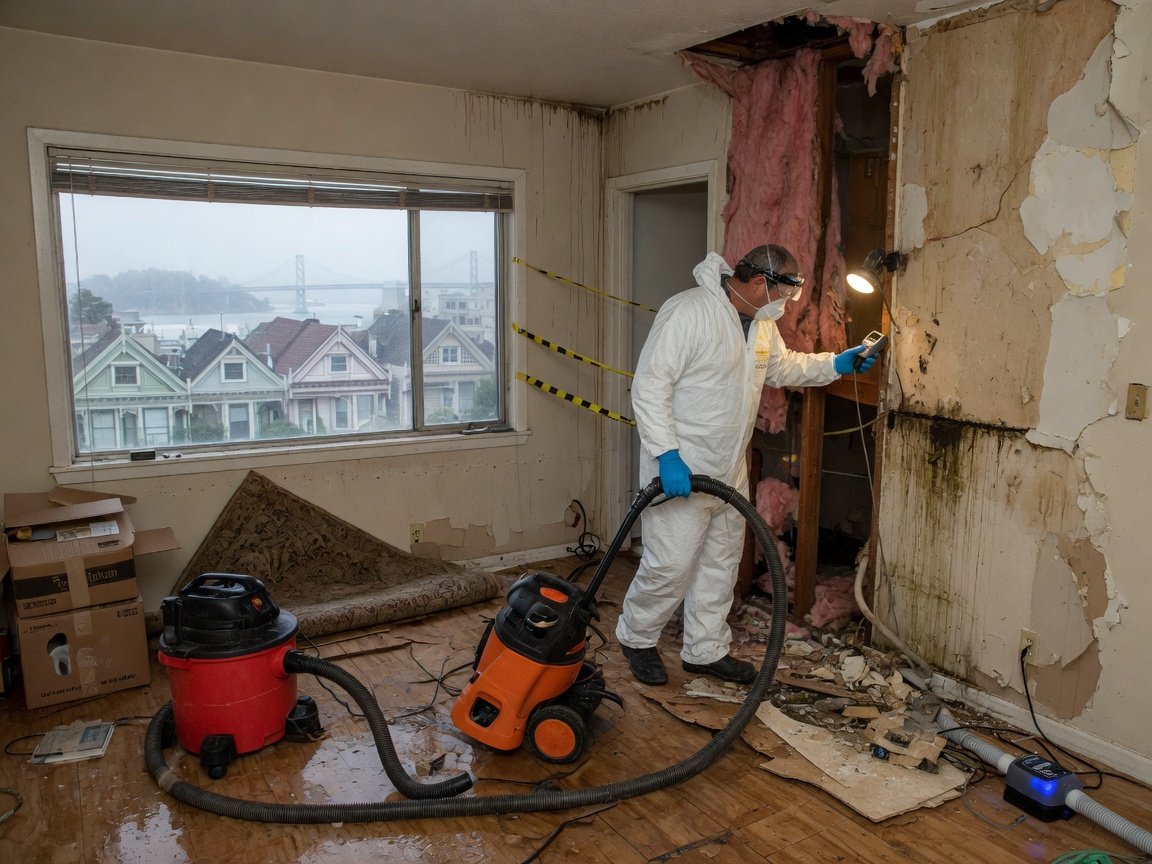
San Francisco's older homes, especially Victorians and Edwardians in the Mission District and Bernal Heights, often hide water damage behind lath-and-plaster walls and under raised floors. Rain and fog during winter months push moisture into basements and crawl spaces where it lingers, leading to rot in joists and subfloors that newer builds rarely see. Extraction and drying must account for these tight cavities and the city's seismic retrofits that can block airflow.
When a pipe bursts in a Noe Valley flat or a roof leak hits a multi-unit building near Valencia Street, the job quickly involves separating wet insulation from historic finishes without triggering further cracking. Equipment placement matters because narrow hallways and steep stairs limit dehumidifier access, and power constraints in pre-1940 wiring affect how many fans can run at once. Skipping thermal imaging here usually leaves pockets of moisture that reappear weeks later.
County rules around waste disposal and disposal of saturated materials add steps that crews working outside the city skip. We pull permits when structural members are involved and coordinate with owners on shared walls common in San Francisco duplexes. The result is a drier structure that meets the realities of this specific housing stock rather than a generic checklist approach.
Homeowners often discover the issue only after musty odors travel through shared vents or when a downstairs neighbor reports staining. Addressing the source, whether a failed sewer lateral or repeated fog-driven condensation, prevents repeat calls that are common in these neighborhoods.
Technician insight
In San Francisco the thing that catches most people out with water damage restoration is how quickly moisture travels through shared lath-and-plaster walls in pre-1900 Mission buildings and then shows up in the neighbor's unit days later.
Mission District Victorian Leak
A kitchen supply line failed on the second floor of a 1908 home near Valencia Street. Water had wicked down through plaster into the first-floor ceiling and along joists into the basement. We extracted, placed drying equipment around the narrow stairwell, and monitored readings for five days until levels matched dry standards. The owner avoided opening walls on two floors.
Water Damage Restoration Services We Offer
✓Emergency Water Extraction
Rapid removal of standing water from basements and ground floors in Mission District Victorians before it reaches neighboring units.
✓Structural Drying for Older Homes
Targeted drying of lath, plaster, and subfloors using equipment sized for narrow San Francisco layouts and limited electrical service.
✓Hidden Moisture Detection
Thermal imaging and moisture meter scans to locate water trapped behind walls and under floors common in pre-1940 buildings.
✓Mold Containment After Leaks
Isolation and removal of mold growth triggered by repeated winter moisture in Bernal Heights and Noe Valley crawl spaces.
✓Content Drying and Storage
On-site and off-site drying of furnishings and belongings from flooded apartments near Valencia Street.
Water Damage Restoration Cost in Francisco, CA
| Service | Typical Range | What Affects It |
|---|---|---|
| Initial Assessment | Free | For visible damage in Mission and Bernal Heights homes |
| Water Extraction | $800–$2,200 | Depends on volume and access in older multi-unit buildings |
| Equipment Drying (per week) | $1,200–$2,800 | Number of units and power limitations move the cost |
| Hidden Moisture Scan | $350–$650 | Thermal imaging in plaster walls |
Ranges are typical for Francisco, CA and confirmed with an exact written quote before any work starts.
How it works
- 1
Site Assessment
We inspect the property at 1195 Valencia St service area, map water paths through older construction, and identify affected materials.
- 2
Water Removal
Pumps and extractors clear standing water while protecting historic finishes in tight Mission District spaces.
- 3
Drying And Monitoring
Industrial dehumidifiers and air movers run until readings confirm dry conditions in plaster and framing.
- 4
Restoration
Replace damaged sections, match existing finishes, and verify no residual moisture remains before turnover.
Pricing
Upfront quotes based on square footage, depth of water, and age of the building; no hidden fees.